The Fielding Circle, Explained Without the Jargon
The cricket fielding circle helps you read limited-overs tactics: see where fielders move, what a captain is protecting and which option suits the match.
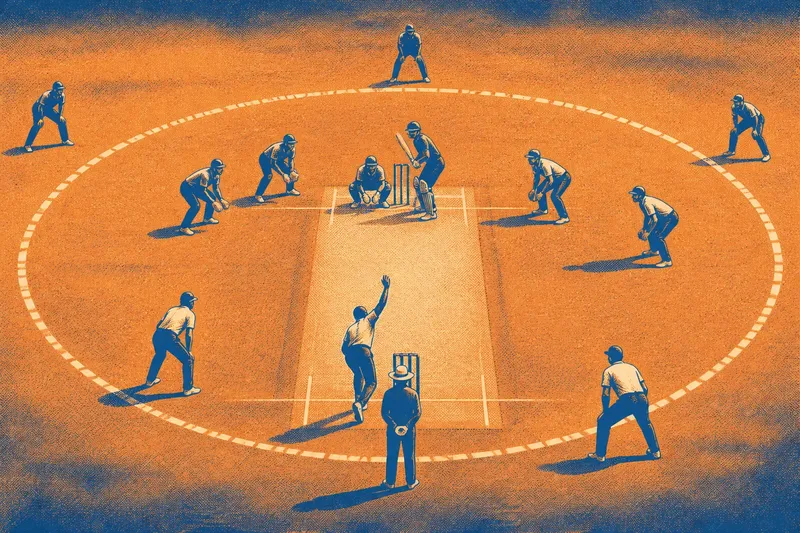
Where did that fielder go, and what is the captain trying to protect? The cricket fielding circle gives you a useful reference for answering both questions during a limited-overs match. It marks a boundary around the pitch area; it does not dictate one fixed arrangement. Watch how the field changes in relation to that mark, and you can see a captain choosing between guarding the boundary, closing gaps and pressuring the batter.
The circle matters because limited-overs conditions place restrictions on how many fielders may be outside it at particular times. Those restrictions vary by format and competition. The practical point for a viewer is simple: the field has an inner area and an outer area, and the permitted balance between them can change. That balance shapes the captain’s choices, but the circle is a guide to reading those choices, not a complete explanation of every delivery.
Reading the boundary
Look for the painted or marked arc around the pitch, usually visible on the outfield. Its exact position and the fielding restrictions that apply depend on the match rules. Treat it as a dividing line between fielders close in and those stationed deeper, rather than as a target that every player must occupy.
A fielder inside the circle is generally closer to the batter and can help cut off singles, stop a ball travelling through an infield gap or create pressure with a catching position. A fielder outside is farther back and better placed to intercept a shot that has passed the inner field. That broad distinction is more useful than trying to memorise every position name.
Think of the circle as the rim of a serving tray: it helps you see which objects are near the centre and which sit at the edge, but it does not tell you what each object is for. A close fielder might be there to attack, protect a particular scoring area or simply cover a likely route. Read the position alongside the bowler’s line, the batter’s stance and the match situation.
Do not assume that a fielder standing just beyond the mark is automatically in the best place to stop a boundary, or that a ring of close fielders means an attacking plan. The ball can travel through a gap, and a batter can play into an unexpected area. The circle helps you locate the fielders; their spacing and movement tell you more about the plan.
Three fielding approaches
In a limited-overs match, think in terms of three broad approaches: protect the boundary, crowd the inner field, or balance both. They are not official labels, and a captain may switch between them from ball to ball. They are useful viewing categories because each gives you a different question to ask.
Protect the boundary
Here, the captain keeps fielders deep in areas where the batter is most likely to hit a boundary. The exact locations depend on the bowler and batter. A leg-side hitter facing a bowler pitching outside off stump may draw a different boundary arrangement from a batter who often drives straight.
This approach suits a situation where preventing a large hit matters more than stopping every single, or where a batter has shown a clear preference for hitting into a particular region. Watch the deeper fielders: are they set on the batter’s stronger side, or spread to cover several likely arcs? If the captain leaves an obvious gap elsewhere, that may be a deliberate trade-off.
Crowd the inner field
With more fielders close to the pitch, the captain can make singles harder and place players in positions that may turn a mistimed shot into a catch. It can also leave less protection at the edge, so a cleanly struck ball may travel for a boundary. The approach asks the batter to find a safe scoring route under pressure.
This can suit a bowler who is aiming to keep the ball in a controllable area or a match passage in which the fielding side wants to challenge the batter’s timing. It is not automatically an attacking field: a close fielder may be positioned to stop a particular shot rather than to take a catch. Look at whether the bowler’s plan and the fielder’s location work together.
Balance both zones
A balanced field places some players close enough to limit easy singles and others deep enough to cover the most likely boundary shots. It cannot cover every angle equally well. The captain has to choose which gaps to accept, and the bowler’s accuracy can make a particular arrangement more or less useful.
This is often the clearest approach for a viewer who is learning the game: identify the most obvious protected area, then notice what has been left open. If the batter takes a single into the uncovered space, that may be an acceptable result for the fielding side. If the same gap is repeatedly targeted, expect a fielder to move or the bowler to alter the line.
What changes tell you?
Do not watch only for a full field change between overs. A single fielder moving a few paces can reveal that the captain is responding to a batter’s preference or a bowler’s plan. Compare the field before and after a delivery, and note what changed: the player’s distance from the boundary, the side of the pitch they cover, or whether a gap has opened.
Say you are watching a batter repeatedly steer balls through the off-side for easy singles. Imagine the captain moves a fielder from a deep position to a spot inside the circle in that channel. The expected observable result is less open space for that particular single, while the deeper boundary area the fielder left behind may become easier to target. You can then watch whether the batter changes the shot or the captain restores the fielder.
That sequence is more revealing than simply noting that the field is “aggressive” or “defensive”. Ask what the move makes harder, what it makes easier and whether the bowler is delivering the kind of ball that uses the new position. A fielder’s location alone does not prove a plan is working; it shows the choice the fielding side is making.
Also notice when the field seems to change after a boundary or a quiet over. A captain may adjust to a batter’s demonstrated hitting area, to the incoming batter, or to the bowler’s next delivery. The circle lets you track those adjustments even when you do not know every fielding term. Keep the focus on the space gained or surrendered.
Which approach fits?
Choose the boundary-protection lens when the most noticeable feature is a cluster of deep fielders or when a batter is repeatedly aiming for the rope. Ask which hitting area the captain expects and whether the bowler is trying to direct the ball towards the protected side.
Choose the inner-field lens when close fielders are prominent and the batter seems to be working the ball for singles. Watch for whether the captain is closing a particular channel, and whether the bowler is making the batter play into it. This lens is especially useful when the score is advancing through small, low-risk shots rather than big hits.
Choose the balanced-field lens when players occupy both zones without an obvious concentration. Compare the likely scoring routes: which single is difficult, which boundary is covered, and where the batter might safely aim? You do not need to decide that one approach is best in the abstract. The useful question is whether the field matches the threat the captain appears to be addressing.
For a quick choice while watching, start with the batter rather than the field diagram. If the batter is seeking a boundary, track the deep players. If they are collecting singles, track the gaps inside. If neither pattern is clear, follow one fielder whose position changes and see what space that move closes or opens.
Questions about the circle?
Does the circle mark a fixed number of fielders?
No. The circle marks an area of the field; limited-overs rules set how many fielders may be outside it at certain stages. The applicable restrictions depend on the competition and format.
Why does a fielder move across the line?
A captain may reposition a player to cover a likely shot, close a route for singles or support the bowler’s intended line. The move may also leave another area less protected, so watch what space is traded away.
Is a close field always attacking?
Not necessarily. A player inside the circle may be there to stop easy runs or cover a specific shot, as well as to create a catching chance. The bowler’s delivery and the fielder’s exact location help clarify the purpose.
How can I read the field without knowing every position?
Divide the field into near and deep areas, then identify the largest open gap and the most heavily protected route. Follow one adjustment and ask what became harder for the batter. That gives you a practical reading without memorising a diagram.
Use the circle as a clue
The fielding circle is most useful when you treat it as a map of choices. It helps you see whether a captain is placing more emphasis on the inner field, the boundary, or a compromise between them. The important detail is not simply how many players are on either side of the mark, but which scoring routes their positions protect.
Next time you watch a limited-overs match, pick one fielder and keep an eye on their location for an over. Note what space they cover, what opens when they move, and whether the batter changes approach. The cricket fielding circle will then become less like a painted rule boundary and more like a visible record of the contest between the captain’s plan and the batter’s choices.