From Timeless Matches to the One-Day Game
Timeless cricket and one-day cricket use different finish lines. Learn how innings, time limits and competition rules shape a match’s official result.
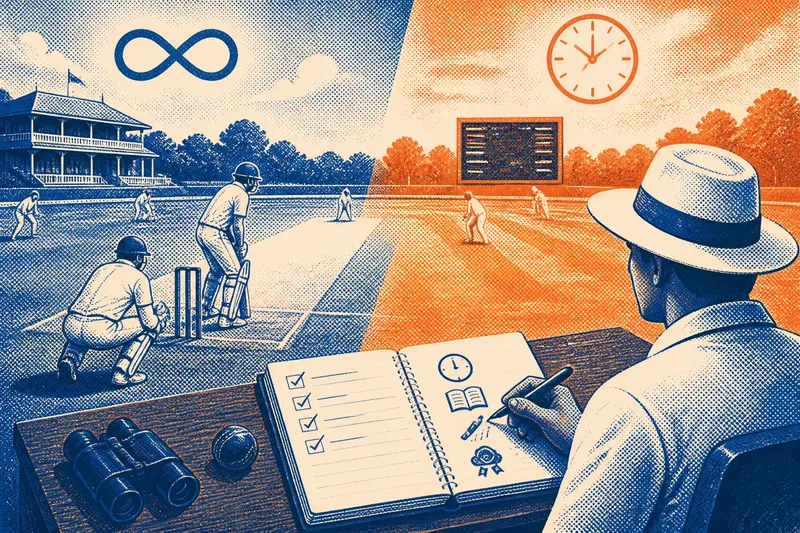
Why can a timeless cricket match keep going while a one-day match has to fit its play into a schedule? The difference between timeless cricket and one-day cricket lies in what sets the finish line: completing the required play or reaching a limit set by the format.
That distinction helps explain why a visible lead is not always a win, why an innings can finish with batters still in, and why an interrupted match needs its official result label rather than a guess from the score.
Different finish lines
In a timeless match, there is no fixed playing-time limit that automatically ends the contest. The intended result depends on completing the required innings, subject to the laws, playing conditions and competition rules in force. “Timeless” does not mean play continues regardless of circumstances: weather, ground conditions, safety concerns and administrative decisions can affect a match.
A one-day match has a scheduled structure, usually with each side allotted a set number of overs. Its playing conditions define how the innings and result work, including how interruptions may affect the available overs or the result method. The format’s limit is part of the contest from the start.
It is like borrowing a book with no agreed return time compared with one that must be back before the library closes. In the first case, finishing the task sets the endpoint; in the second, the closing time matters too.
When play stops
A clock reaching the end of a scheduled period does not, on its own, create a winner. The result depends on the format, the state of the innings and the applicable playing conditions. A side’s lead at the moment play stops may not be enough to settle the match.
In timeless cricket, an incomplete set of required innings does not automatically mean the match is a draw. Depending on the competition’s rules and the match’s status, it may be recorded as a draw or classified another way. Check the official result and the playing conditions rather than treating a draw as universal.
In one-day cricket, completed innings and the final scores usually make the result clear, but interruptions can change the available play or the method used to decide the match. A tie, a draw and a no result are distinct outcomes; the competition’s regulations determine which applies in a particular situation.
When a match stops unexpectedly, check these points in order:
- Check the format and playing conditions; if they specify a result method, use it, otherwise consult the official competition rules.
- Check whether the required innings are complete; if they are not, do not infer a win from the score, and look for the official classification.
- Check the final scores; if they are level under the applicable conditions, look for a tie or any tie-breaking procedure, otherwise compare them only if the match conditions permit a result.
- Check whether an interruption changed the overs or result method; if it did, apply that revised method, otherwise use the original playing conditions.
- Check the official result label; if it says draw, tie or no result, use that classification, otherwise consult the competition’s published result record before describing the outcome.
- Check whether the match was abandoned or otherwise affected by a formal decision; if so, use the recorded status, otherwise do not treat a temporary stoppage as the final outcome.
Why overs matter
An over limit shapes how a team plans an innings. In a match without a fixed overs allocation, batters may concentrate on staying in and building a substantial total, while bowlers seek to take wickets and end the innings. In a one-day match, the batting side must also manage a finite supply of deliveries.
An innings can therefore end when the allotted overs are used even though wickets remain. That is different from being all out. On a scorecard, compare the overs used with the wickets lost to see whether the innings ended at its limit or through dismissals.
The limit also gives the bowling side a defined task: restrict the scoring and take wickets within the available overs. It does not need to dismiss every batter for the innings to be complete.
How results differ?
Does a lead mean a win?
No. Check whether the innings and conditions required for a result have been met, then read the official classification. An unfinished match may not award victory to the side that was ahead when play stopped.
Can an innings end with wickets left?
Yes. In limited-overs cricket, an innings can end when the side uses its allotted overs, even if batters remain. Check the overs and wickets on the scorecard to see how it ended.
What is the difference between a draw and a tie?
A tie means scores are level under the relevant result conditions. A draw is a separate classification, generally used when a match ends without a winner and without being a tie; the competition rules govern the precise outcome.
Why might an interrupted one-day match have no result?
If an interruption leaves too little play to decide the match under the competition’s rules, it may be recorded as no result. A side’s position when play stops does not by itself settle the contest.
Reading a result
Imagine a fictional timeless match in which the first side scores 240 and the second has made 180 when play ends, with required innings still unfinished. The second side has not passed the first, but that lead alone does not make the first side the winner. The reader checks the match’s playing conditions and official record; if those classify the unfinished contest as a draw, the answer is a draw, while a different classification under the applicable rules must be reported as recorded.
Now imagine a fictional one-day match in which the chasing side reaches the end of its allotted overs below the target, and the conditions say the completed innings determine the result. The reader compares the totals and records a win for the side with the higher score. If an interruption altered the overs or result method, the reader instead applies those revised conditions before deciding what the score means.
Timeless cricket and one-day cricket give a score different context because they set different boundaries for completion. When a result looks unclear, check the format, the innings, any interruption and the official classification; that sequence is more reliable than turning a temporary lead into a verdict.